.png)
Construction Industry Talent Sourcing: The 2026 Guide to Finding Skilled Workers
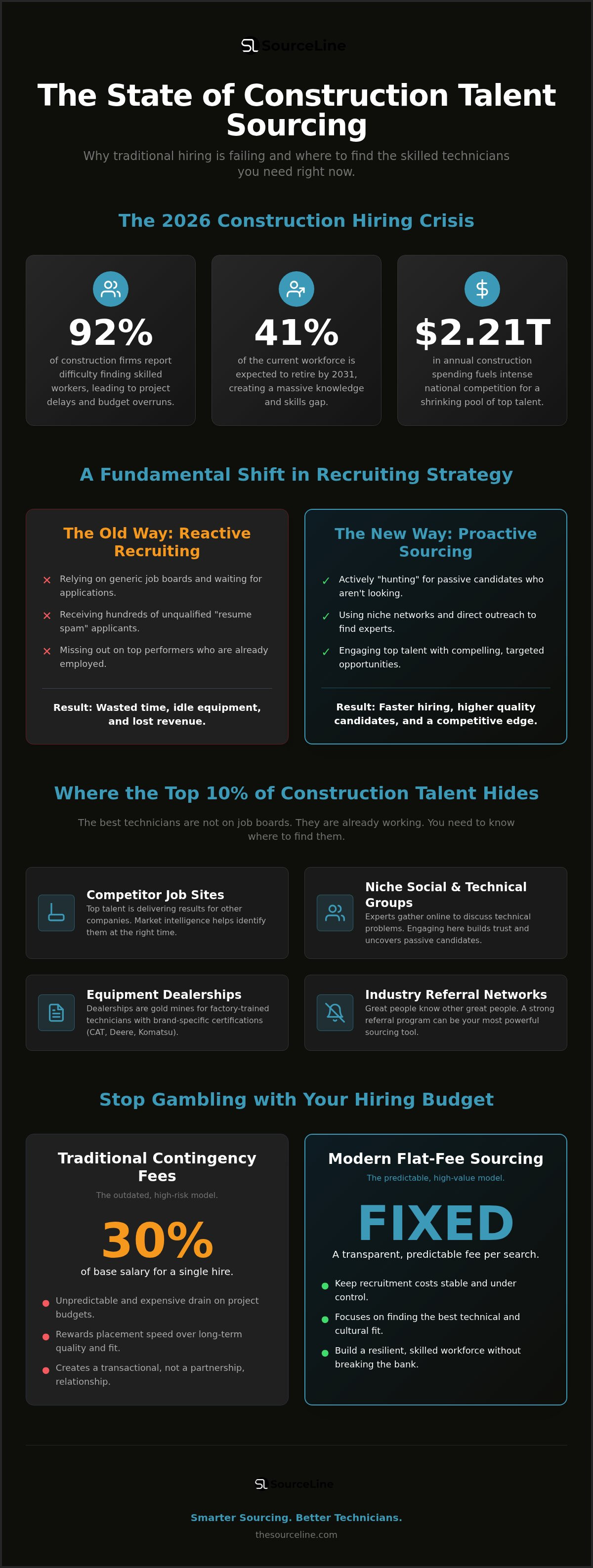
Nearly 92% of construction firms report difficulty finding skilled workers in 2026. You likely feel this pressure every time a candidate ghosts an interview or a specialized role stays open for months. Traditional headhunters often charge up to 30% of a base salary for a single hire. This outdated model is becoming a massive drain on project budgets and company growth.
Finding the right people shouldn't feel like an expensive gamble. You need a reliable way to reach passive candidates who aren't actively browsing job boards. Modern construction industry talent sourcing requires a proactive hunter mentality that focuses on technical expertise over simple keywords.
This guide will teach you how to identify and attract top talent using smarter sourcing strategies and flat-fee hiring models. We'll show you how to lower your time-to-hire while keeping your recruitment costs predictable. You can stop overpaying for talent and start building a more resilient, skilled workforce today.
Table of Contents
The Reality of Construction Industry Talent Sourcing in 2026
Successful construction industry talent sourcing is no longer about waiting for applications. It is the proactive process of finding and engaging skilled labor before they even look for a job. Traditional recruiting is reactive. Sourcing is a hunt. You have to identify the right people and convince them that your project is worth their time.
The market in 2026 is tighter than we have seen in decades. Nearly 41% of the current construction workforce is expected to retire by 2031. Many of those veteran workers are hanging up their hard hats right now. This creates a massive knowledge gap. Younger workers are entering the field, but they often lack the specialized diagnostic skills of the baby boomer generation.
Demand is also hitting record levels. As of May 2026, the annual rate of construction spending in the U.S. reached $2.21 trillion. Infrastructure projects are fueled by massive funding. You aren't just competing with the shop across town anymore. You are competing with every major federal and state project in the country. This makes the search for talent a national race.
Finding a heavy equipment mechanic or a lead superintendent is the hardest part. These aren't just "parts changers." They are technical experts who understand complex hydraulics and AI-integrated machinery. If you need specialized skills, you won't find them through a basic search. You need a strategy that targets the specific expertise your projects require.
Why Traditional Job Boards are Failing Construction
Top-tier technicians are rarely browsing Indeed or ZipRecruiter. They are already working. Most of these professionals have been at the same company for years and don't even have an updated resume. They don't need one because they are in high demand. If a worker is constantly refreshing a job board, you have to ask why they aren't already busy in this market.
When you post on a generic board, you usually get "resume spam." You end up sorting through hundreds of unqualified applicants who clicked "apply" just to meet a quota. This wastes your time and keeps your machines idle. Every day a piece of equipment sits without a tech, your company loses money. You need a faster way to reach the people who actually know how to do the work.
The Shift Toward Passive Candidate Sourcing
Effective Sourcing (personnel) focuses on passive candidates. These are people currently employed who aren't actively looking for work but would move for a better opportunity. These candidates are often the highest quality workers. They have proven track records and are currently delivering results for your competitors.
You have to change your mindset to win these workers over. Stop waiting for the phone to ring. You need to be a proactive hunter. This is why heavy equipment recruiting has shifted toward direct outreach. It is about finding the person who fits the role and explaining why your shop offers more stability or better pay. If you want the best, you have to go get them.
Where the Top 10% of Construction Talent Hides
The best workers in this sector aren't looking for you. They are already on a job site, delivering results for someone else. These individuals aren't scrolling through Indeed at night. To find them, you need a proactive approach to construction industry talent sourcing that goes beyond waiting for applications.
According to Construction industry workforce statistics, specialty trade contractors make up the largest portion of the workforce. This is where your best candidates are currently working. They are at equipment dealerships, independent repair shops, and specialized firms. You have to go to where they are already successful.
Social media is a powerful tool for connection, but not for traditional ads. Join specialized groups where operators and mechanics discuss technical issues or troubleshoot equipment. Listen to their problems. When you engage with them as a peer or an industry expert, you build the trust needed to recruit them later. This is how you identify the "passive" candidates who aren't on the open market.
Market intelligence is your secret weapon. You should know which competitors are finishing large projects or losing contracts. This allows you to time your outreach perfectly. If you want to see how this intelligence works in practice, explore our heavy equipment recruiting services to see how we track these trends across the country.
Leveraging Specialized Technical Networks
Dealerships are gold mines for talent. These technicians often have factory training and specific certifications from brands like Caterpillar, Komatsu, or John Deere. You should also look at former military technicians who worked on heavy vehicles. These individuals already have the discipline and technical foundation you need to hit the ground running.
Trade school partnerships are another long-term play. Don't just show up for career day. Offer to guest lecture or donate equipment for training. This builds your brand with the next generation of talent before they even graduate. High-quality workers know other high-quality workers, so never underestimate the power of a strong industry referral program.
Direct Outreach and the Hunter Mentality
A generic job description is a waste of time. These professionals get several of those messages a week. You need a personalized message that shows you actually understand their specific skills. Pitch the role as a career move that offers more than just another paycheck.
Focus on what actually matters to them. This might be better equipment, a shorter commute, or a clearer path to a lead technician role. A headhunter acts as the bridge between your company and these busy professionals. They break through the noise of daily work to start a real conversation about the future.
Comparing Sourcing Models: Why Flat-Fee Beats Contingency
How much is your recruiter actually costing you? Traditional recruiting relies on a contingency model. This means the agency gets paid a percentage of the candidate's first-year base salary. In 2026, these fees typically range from 20% to 25%. This model often creates a conflict of interest. The more you pay your new hire, the more the recruiter makes. It doesn't reward finding the best fit. It rewards the highest price tag.
SourceLine operates on a flat-fee model. You pay one fixed price for the search regardless of the final salary. This approach changes the entire dynamic of construction industry talent sourcing. We focus on finding the right technical skills rather than inflating the offer. It turns the recruiter into a partner who wants to save you money rather than a vendor looking for a bigger commission check.
Let's look at the math for a $100,000 service manager role. Under a 25% contingency agreement, you owe the agency $25,000 the moment that manager signs. That is a massive upfront cost that eats into your project margins. With a flat fee, that cost is capped and known from day one. The Occupational Outlook Handbook projects steady growth for these leadership roles. As salaries rise, percentage-based fees will only get more expensive.
The Hidden Costs of Percentage-Based Fees
High fees often lead to bad hiring decisions. If a fee is too high, a department head might settle for a "parts changer" instead of a true diagnostic tech just to stay under budget. This is a trap. You save on the fee but lose thousands in rework and equipment downtime. A flat-fee model removes this pressure. You can hire the best person for the job without worrying about a ballooning recruitment bill.
Many firms also fall into the temporary staffing trap. They pay a high hourly markup for months because they don't want to pay a large direct-hire fee. You end up paying double the actual salary over time. Flat fees make direct hiring accessible. They allow you to own your talent from the start. This is vital for long-term projects where you need a stable, committed crew.
Transparency and Predictability in Hiring
Knowing your costs upfront reduces the stress of building a team. You can bid on large infrastructure projects with confidence because your labor acquisition costs are fixed. There are no surprises when the final invoice arrives. This predictability is essential for high-volume needs where you might be hiring ten or twenty technicians at once.
A flat-fee partner works as an extension of your team. We provide the same high-level sourcing and prescreening without the variable costs. You get access to the same passive candidates and industry experts for a predictable investment. You can see how this works by visiting the SourceLine pricing page for real-world examples of our model. It's a straightforward way to keep your project budgets on track while securing the top 10% of talent.
Best Practices for Prescreening Construction Candidates
Prescreening is where you separate the real technicians from the resume writers. In a tight market, construction industry talent sourcing often brings in a mix of candidates. You don't want to waste your shop foreman's time with a "parts changer." You need a diagnostic expert who can find the root of a hydraulic failure on a job site.
Start by looking for red flags that generalist recruiters often miss. Does the resume show four jobs in two years? In the skilled trades, that's usually a sign of performance issues or reliability problems. Look for specific mentions of tools and software. A real tech will mention ET for Cat or Service ADVISOR for Deere.
Safety records are non-negotiable. If the role requires a CDL-A, verify the license and medical card in the first five minutes. Ask about their driving record early. You don't want to fall in love with a candidate only to find out they aren't insurable.
Vetting Technical Skills and Experience
Ask specific, open-ended questions during the first call. Don't ask if they know hydraulics. Ask them to walk you through how they would troubleshoot a slow-moving boom on an excavator. Their answer will tell you if they understand the system or just know how to turn a wrench.
Verify their experience with specific brands. A tech who spent ten years on John Deere equipment will have a different knowledge base than someone who only worked on Komatsu. You can find more detail on this in our heavy equipment recruiting guide. It helps you refine your construction industry talent sourcing for specialized roles.
Evaluating Culture and Reliability
Field work is a different beast than shop work. Ask the candidate about the worst conditions they have worked in. You need to know if they are willing to crawl under a machine in the mud or work in sub-zero temperatures. If they hesitate, they might not be a fit for your field service team.
Reference checks in the trades should be thorough. Don't just talk to HR. Talk to a former foreman or service manager. Ask them if they would hire the person back.
This one question often reveals more than a thirty-minute interview ever could. Soft skills also matter for leadership roles. A lead tech needs to be able to mentor juniors without losing their temper.
How SourceLine Simplifies Your Construction Hiring
SourceLine takes the guesswork out of construction industry talent sourcing by acting as a direct extension of your team. We don't just post jobs and wait for the phone to ring. We hunt. Our team uses over 20 years of industry experience to find the people who actually know how to fix machines and lead crews.
We understand the technical nuances of your shop. We know that a heavy equipment mechanic needs a different skill set than a highway truck tech. Our focus is on providing you with the top 10% of talent. This means you stop wasting time on unqualified leads and start talking to professionals who can hit the ground running.
Our nationwide reach allows us to support construction fleets across the United States. Whether you need a lead tech in a rural area or a service manager in a major city, we have the network to find them. We handle the heavy lifting of sourcing and technical prescreening. You only see the candidates who are ready to do the work and fit your culture.
A Partner Who Speaks Your Language
We specialize in heavy equipment, heavy truck, and construction recruiting. We don't do office roles or general labor. This niche focus allows us to maintain deep market intelligence and a massive network of passive candidates. Our proactive hunter persona means we are constantly talking to the people your competitors are trying to keep.
Our team understands the difference between a parts changer and a diagnostic expert because we live in this industry every day. We know what a fair wage looks like in your specific region and what it takes to move a top tech from one shop to another. You can learn more about our history and industry roots on our About page.
Getting Started with Flat-Fee Sourcing
Starting a search with us is a straightforward process. We begin with a deep dive into your specific technical needs and shop culture. We want to know exactly what kind of equipment you run and what kind of leadership style works best for your team. This ensures we don't just find a warm body, but a long-term fit.
Within the first 30 days of a partnership, you can expect a steady stream of prescreened, qualified candidates. We keep your costs predictable with our flat-fee model, which allows you to build your team without budget surprises. You get the expertise of a seasoned headhunter with the transparency of a fixed price. It is time to move away from outdated hiring models and start building a stronger workforce.
Build Your 2026 Construction Team
The labor shortage is a permanent reality for the skilled trades. You need a strategy that targets the top 10% of workers who aren't actively scrolling through job boards. Effective construction industry talent sourcing means being a proactive hunter and using technical prescreening to find true diagnostic experts. This approach keeps your machines running and your projects on schedule while reducing the cost of bad hires.
SourceLine brings 20 years of technical recruiting experience and a nationwide reach to every search. Our flat-fee model removes the stress of hidden percentages and high contingency costs that eat into your project margins. You get a dedicated partner focused on finding the right technical fit for your heavy equipment or construction fleet with complete price transparency.
It is time to take control of your hiring process. We are ready to help you find the skilled tradespeople you need to grow your business with confidence.
Frequently Asked Questions
What is the difference between talent sourcing and recruiting in construction?
Talent sourcing is the proactive search for skilled workers who are not actively looking for a new job. Recruiting is the full process that follows, including interviewing, vetting, and final hiring. Sourcing is the "hunting" phase of construction industry talent sourcing where you find passive talent that your competitors are currently employing.
How much do construction headhunters typically charge?
Traditional contingency headhunters usually charge between 20% and 25% of the candidate's first-year base salary in 2026. Some agencies may charge as high as 30% for senior leadership or highly specialized roles. These fees are often unpredictable and can create a massive upfront expense for your company the moment a new hire signs an offer.
Is flat-fee recruiting better for small construction companies?
Flat-fee recruiting is often better for small firms because it provides budget certainty. You know exactly what the hire will cost before the search even begins. This prevents the surprise of a large bill that could eat into your project margins. It allows smaller companies to compete for top talent without the financial risk of percentage-based fees.
How do you find heavy equipment technicians who are not on job boards?
You find these technicians by using market intelligence and networking in specialized technical groups. Most top-tier techs are already working and don't have updated resumes on generic job sites. Reaching them requires direct outreach and a personalized pitch that highlights better equipment, better pay, or a more stable work environment than their current shop.
What should be included in a construction job description to attract top talent?
Include specific equipment brands like Caterpillar, Deere, or Komatsu to show you understand the technical work. Mention clear career paths and specialized training opportunities that show a long-term commitment to the worker. Top professionals want to know they will be working with modern tools and have a chance to move into lead or management roles.
Can I use a sourcing firm for CDL-A driver recruiting?
Yes, you can use a specialized sourcing firm to find high-quality drivers for your fleet. We specifically handle heavy truck and CDL-A recruiting for the construction and heavy equipment sectors. This approach helps you find drivers who have experience with specialized trailers and heavy hauls rather than just general freight.
What are the most in-demand construction roles in 2026?
Heavy equipment mechanics and specialty trade contractors are the most difficult roles to fill in 2026. There is also a significant shortage of experienced project managers and superintendents as more veteran workers retire. High demand for infrastructure projects has made these technical and leadership roles the most competitive in the construction industry talent sourcing market.
Does SourceLine offer temporary staffing for construction projects?
No, SourceLine does not offer temporary staffing services. We focus exclusively on permanent, direct-hire placements for skilled trades and leadership roles. Our goal is to help you build a stable, long-term workforce rather than providing short-term labor. This focus ensures you get committed employees who are invested in the long-term success of your company.


Comments