.png)
Guide to Recruiting Specialized Yacht Technicians
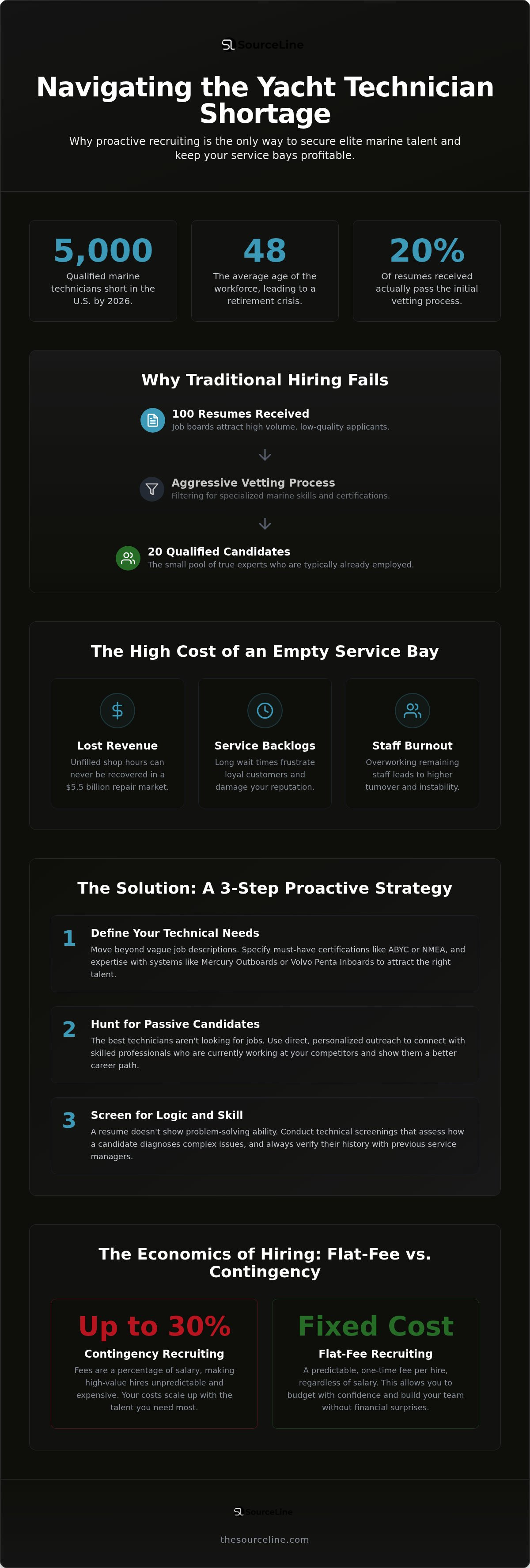
Industry data shows that for every 100 resumes received in the yachting sector, only 20% actually pass the vetting process. This explains why your inbox is often full of car mechanics instead of marine specialists. Finding a tech who understands ABYC or Mercury systems feels like searching for a needle in a haystack. Using the right yacht technician recruiting services is the only way to filter out the noise and find true experts.
You likely agree that service department turnover is a constant headache. It is hard to keep a predictable schedule when you have long vacancies during the peak boating season. Paying a high percentage-based fee for every new hire only adds to the stress. You need a way to find certified professionals without draining your budget.
This guide explains how to source and hire top-tier technicians using a proactive strategy. You will learn how to secure the talent you need while keeping your recruiting costs fixed. We will show you how to move past passive job boards and start finding the people who are already doing the work.
Table of Contents
Understanding the Yacht Technician Shortage in 2026
The marine industry is hitting a wall. As of July 2026, the U.S. faces a shortage of 5,000 qualified marine technicians. This isn't just a temporary dip in the labor market. It's a structural crisis driven by an aging workforce with an average age of 48. When these veterans retire, they take decades of specialized knowledge with them. Replacing that expertise is becoming the biggest challenge for marina managers today.
General job boards don't solve this problem. You might post an ad and get 50 resumes, but 40 of them are likely from car mechanics or general laborers. High-quality marine talent isn't looking for work on generic sites. They are already working at your competitors. This is why standard hiring methods fail and why specialized yacht technician recruiting services are becoming the industry standard for those who need real results.
It's also vital to distinguish between general crew and technical staff. A deckhand keeps a boat clean and assists with support and service vessels, but they don't have the diagnostic skills to rebuild a Volvo Penta IPS drive. Hiring a mechanical enthusiast instead of a certified marine technician is a recipe for a warranty disaster. You need people who understand the unique physics of the marine environment.
Why Specialized Skills Matter More Than Ever
Modern yachts are floating computers. Today's systems require deep knowledge of NMEA 2000 networking and complex AC/DC power management. Manufacturers like Mercury and Yamaha now mandate specific certifications for any warranty work. If your tech isn't certified, you can't bill the manufacturer for the repair. One mistake on a high-voltage system can cause six figures in damage and ruin your reputation with a client.
The Cost of an Empty Service Bay
Every hour a service bay sits empty is money leaving your business. With the boat repair market projected to hit $5.5 billion this year, the demand for service is at an all-time high. A single unfilled tech role leads to several negative outcomes:
Unfilled shop hours that can never be recovered.
Long service backlogs that frustrate your loyal customers.
Increased burnout and turnover among your remaining staff.
This creates a cycle of instability that is hard to break without a better approach to yacht technician recruiting services. You need a predictable pipeline of talent to keep your bays full and your revenue growing.
How to Source High-Quality Yacht Technicians Proactively
Waiting for the right person to find your job post is a losing game. This "post and pray" method usually results in a pile of resumes from automotive mechanics or general laborers. The reality of the 2026 market is that the best technicians are already working. They don't spend their evenings browsing job boards because they don't have to. To find them, you must shift from a passive recruiter to a proactive hunter.
Successful hiring starts with identifying where your ideal candidates are currently working. Look at local competitors or dealerships that handle similar brands. Direct outreach allows you to tell your story before a candidate even realizes they are ready for a change. High-quality yacht technician recruiting services focus on these passive candidates to ensure you get the top 10% of talent, not just who is available.
Step 1: Define Your Technical Requirements
Precision prevents wasted time. Before you start reaching out, decide exactly what your shop needs to stay profitable. Are you looking for a specialist in Mercury outboards or someone who can handle a Volvo Penta diesel inboard? List the must-have certifications like ABYC or NMEA upfront. Knowing these requirements helps you filter candidates based on their actual capabilities rather than vague claims of being "good with tools."
Step 2: Proactive Industry Outreach
Once you know who you need, you have to go get them. Use specialized tools to find technicians in your specific region. When you reach out, avoid generic templates that look like spam. Mention their specific background and explain why your shop is a better fit for their career. Focus on tangible benefits like shop culture, updated equipment, and clear paths for advancement. A personalized message shows you value their expertise.
Step 3: Screening for Culture and Skill
A resume only tells part of the story. Use initial phone screens to dig into their technical logic. Instead of asking what they fixed, ask how they diagnosed a specific problem. A tech who can explain their troubleshooting process for a complex electrical issue is worth more than one who just replaces parts. Always verify their history by speaking with past service managers who understand the daily pressure of a marine shop. If you find this process overwhelming, professional marine and boat industry recruiting can handle the heavy lifting while you stay focused on your customers.
Screening for Technical Excellence: A Marine Skills Framework
Marine environments are unforgiving. Saltwater, constant vibration, and high humidity destroy systems that work fine on land. A car mechanic might understand an engine, but they often lack the "marine eye" needed to spot corrosion or improper bonding. Effective yacht technician recruiting services focus on finding techs who respect these environmental factors and understand the physics of a vessel on the water.
Propulsion systems vary wildly in the yachting world. You need to know if a candidate can handle complex outdrives, traditional shafts, or modern jet drives. Screening must involve specific questions about their hands-on experience with these systems. A candidate who only knows outboards might struggle with a 60-foot yacht's diesel inboard setup. Your screening process must filter for these distinctions early.
Mechanical and Engine Diagnostics
Modern engines require more than just a wrench. Technicians must be proficient with computerized diagnostic tools for brands like Mercury, Volvo Penta, or CAT. Ask candidates to walk you through a recent troubleshooting session involving an intermittent fault code. This reveals their logic and their familiarity with the manufacturer's software. Use these specific points to evaluate their mechanical depth:
Verify experience with seasonal service cycles like winterization and spring commissioning.
Test their knowledge of fuel system safety and cooling system pressure testing.
Ask them to explain the difference between closed-cooling and raw-water systems.
Confirm they can perform engine alignments and shaft packings.
Marine Electrical and Electronics
Electrical failures are the leading cause of service calls. A specialized tech must master NMEA 2000 networking and integrated electronics installation. They should also understand complex battery management, including AGM and Lithium systems, along with charging and inverter setups. Without these skills, a tech is likely to cause more problems than they solve on a modern vessel.
Yacht automation is becoming the norm. Screen for candidates who can troubleshoot digital switching systems like CZone or EmpirBus. These roles require a blend of IT knowledge and traditional electrical skills. Specialized marine and boat industry recruiting helps you find people who won't be intimidated by a digital switching failure or a complex Garmin network integration.
Finally, consider the dealership or marina setting. Technicians often interact with high-net-worth boat owners. They must be able to explain complex repairs in simple terms without sounding condescending. A technician with great mechanical hands but poor communication skills can still hurt your customer retention. Look for the "complete package" to ensure your service department runs smoothly.
The Economics of Hiring: Flat-Fee vs. Contingency Recruiting
Traditional headhunters operate on a commission. They usually charge between 20% and 30% of a technician's first-year salary. For a specialized yacht mechanic, this leads to a massive bill. It also creates a conflict of interest. The recruiter wants a higher salary for the candidate because it means a bigger check for them. This doesn't help your service department's bottom line.
Modern yacht technician recruiting services are moving away from this model. A flat-fee approach provides a fixed cost regardless of what you pay the new hire. You can plan your budget with confidence. You won't be surprised by a high fee just because you found a highly certified lead tech. It's a much more transparent way to build a team.
Why the Percentage Model is Outdated
The percentage model actually punishes you for being a good employer. If you offer a competitive wage to attract the best talent, the agency charges you more. It makes no sense. Agencies also tend to focus on the easiest roles to fill. They want the quick commission rather than the difficult search for a master technician. Fixed fees change the dynamic. The focus stays on finding the right person for the shop, not the biggest payout.
Comparing the Real Costs
Let's look at the math. If you hire a technician at a $70,000 annual salary, a 25% contingency fee is $17,500. That is a huge hit to your ROI before the tech even turns their first wrench. Flat-fee sourcing delivers the same high-quality candidate for a fraction of that price. You get a U.S.-based sourcing team and a 30-day replacement guarantee without the commission trap. Check out the SourceLine Pricing page to see how this works in practice.
Recruiting costs should be predictable. You shouldn't have to choose between a fair salary and a manageable hiring fee. By using a flat-fee partner, you keep more revenue in your service department. This allows you to invest back into your tools and facility. It's a smarter way to manage your growth.
Hiring a new tech shouldn't feel like a gamble. When you pay a commission, you're paying for the recruiter's success, not necessarily your own. Service managers often find themselves stuck between a rock and a hard place. They need the talent, but the entry price is too high. This is why many marinas are looking for alternative yacht technician recruiting services.
A service bay that generates $150 per hour needs to be active. If a bay sits empty for three months while you argue over a $20,000 headhunter fee, you've lost $72,000 in potential revenue. The total cost of a bad hiring model is much higher than just the fee itself. It's the lost opportunity and the friction in the negotiation process.
Building Your Service Team with SourceLine Recruiting
SourceLine does not operate like a typical staffing agency. We are proactive hunters who focus on the top 10% of technical talent. Our process is designed to take the burden off service managers. We handle the sourcing and prescreening so you can stay focused on getting boats back on the water.
We provide nationwide recruiting for marinas and boat manufacturers. Whether you are in a major coastal hub or a small inland lake market, we know how to find the specialists you need. Our yacht technician recruiting services are built on a flat-fee model. This ensures our interests are always aligned with yours.
Risk management is part of our strategy. We offer a 30-day replacement guarantee on every hire. If a technician isn't the right fit within the first month, we find a replacement at no extra cost. This provides peace of mind when you are expanding your team during the high-demand season. It's a no-nonsense approach to building a reliable service department.
A Partner Who Knows the Marine Industry
We speak the language of the shop. Our recruiters understand that a rigger has a different skill set than a gelcoat technician or a master engine tech. We don't send you general laborers and hope for the best. You can read more About SourceLine and our history in the skilled trades to see why we are different.
Get Started with a Talent Call
Building a better team starts with a conversation. We offer a brief talent call to discuss your specific technical needs and shop culture. This allows us to create custom messaging that attracts the right people to your yard. We don't use generic templates that candidates ignore. Instead, we highlight the unique benefits of working for your business.
Explore our Marine Recruiting Services today to see how we can help you eliminate your service backlog. We are ready to help you find the technicians who will keep your customers happy. Stop waiting for the right resume to appear and start a proactive search today.
Takeaway: Review your current open roles and identify your most critical technical gap. Schedule a call to start a proactive search before the next peak season begins.
Take Control of Your Service Shop Growth
Building a high-performing service department isn't about luck. It requires moving away from outdated hiring models that drain your budget with high commissions. By choosing proactive yacht technician recruiting services, you find the specialized talent your marina needs to stay profitable through every season. You no longer have to settle for whoever happens to be looking for a job on a generic board.
Our approach focuses on deep industry knowledge and complete transparency. We eliminate the stress of the hunt by providing a 30-day replacement guarantee and a flat-fee structure. You won't deal with percentage-based fees that punish you for paying competitive wages. Instead, you get access to a U.S.-based team that knows the difference between a rigger and a certified master technician.
Don't let an empty service bay limit your shop revenue. You can start building a more reliable team right now by speaking with experts who understand the marine world. Your shop deserves a staffing partner that works as hard as your best lead tech.
Frequently Asked Questions
What is the average cost of yacht technician recruiting services?
Traditional contingency recruiters typically charge between 20% and 30% of a technician's first-year salary. This can result in a fee of $15,000 or more for a single hire. A flat-fee model provides a much more predictable cost by charging a one-time fixed price regardless of the final salary. This allows marina managers to budget effectively without worrying about hidden commissions or rising costs.
How do I find marine technicians with ABYC certifications?
Finding ABYC certified professionals requires a proactive search through specialized industry databases and direct outreach. Most certified technicians are already employed and aren't actively checking common job boards. Specialized yacht technician recruiting services focus on identifying these passive candidates. We verify their certifications and manufacturer training before they ever reach your service manager's desk for an interview.
Why should I use a flat-fee recruiter instead of a contingency agency?
Flat-fee recruiters remove the conflict of interest that often occurs with percentage-based commissions. In a contingency model, the recruiter makes more money if the candidate's salary is higher. A fixed-fee partner is incentivized only to find the best technical fit for your shop. This transparency leads to better negotiations and a more honest relationship between you and your new employee.
How long does it typically take to find a qualified yacht mechanic?
A successful search for a specialized marine mechanic usually takes between 30 and 60 days. This timeframe can vary based on your specific engine requirements or regional location. Proactive sourcing methods often shorten this window by engaging candidates who are ready for a career move. Waiting for the right person to apply to a job post can often take much longer during peak season.
Do you recruit for mobile marine service businesses?
Yes, we provide recruiting for mobile marine operations that need technicians with high levels of independence. Mobile techs require strong diagnostic skills and the ability to work without a traditional shop support system. We screen for these specific traits to ensure they can handle the unique challenges of field service. Our process remains the same whether the tech is based in a bay or a service van.
What happens if a technician hired through a recruiter leaves within a month?
We provide a 30-day replacement guarantee to protect your hiring investment from early turnover. If a new hire doesn't work out or leaves for any reason in the first month, we will find a replacement candidate at no extra cost. This guarantee reduces the financial risk of a bad hire. It ensures that your service department gets the technical talent it needs without paying a second fee.
Can you help find service managers for large marinas?
Recruiting for leadership roles like service managers or shop foremen is a core part of our marine industry services. These positions require a mix of deep technical knowledge and the ability to manage a diverse team of technicians. We look for candidates who have proven experience in improving shop efficiency and customer retention. Finding the right leader is essential for scaling your service operations successfully.


Comments