.png)
Heavy Equipment Mechanic Headhunters: The 2026 Guide to Flat-Fee Sourcing
Updated: Jul 23
Is your shop losing $1,000 or more in billable revenue every day because of an empty bay? With 54% of heavy-duty repair shops reporting understaffing in 2026, the cost of a vacancy is no longer just a headache; it's a structural financial drain. Most heavy equipment mechanic headhunters still operate on a percentage-based model that rewards them for high salaries rather than high-quality fits. You end up paying 25% or more of a technician's first-year pay for a candidate who might not even hold the right certifications.
It's time to stop waiting for resumes and start hunting for results. We understand that you're tired of generic recruiters who don't know a hydraulic system from a wire harness. This guide promises to show you how to bypass the technician shortage and secure the top 10% of technical talent using a predictable, flat-fee model that keeps your hiring costs transparent. We will preview the proactive "hunter" strategy that replaces the "post and pray" method with a stream of prescreened, certified mechanics who are ready to turn wrenches on day one.
Table of Contents
The 2026 Heavy Equipment Technician Shortage: A Crisis of Capacity
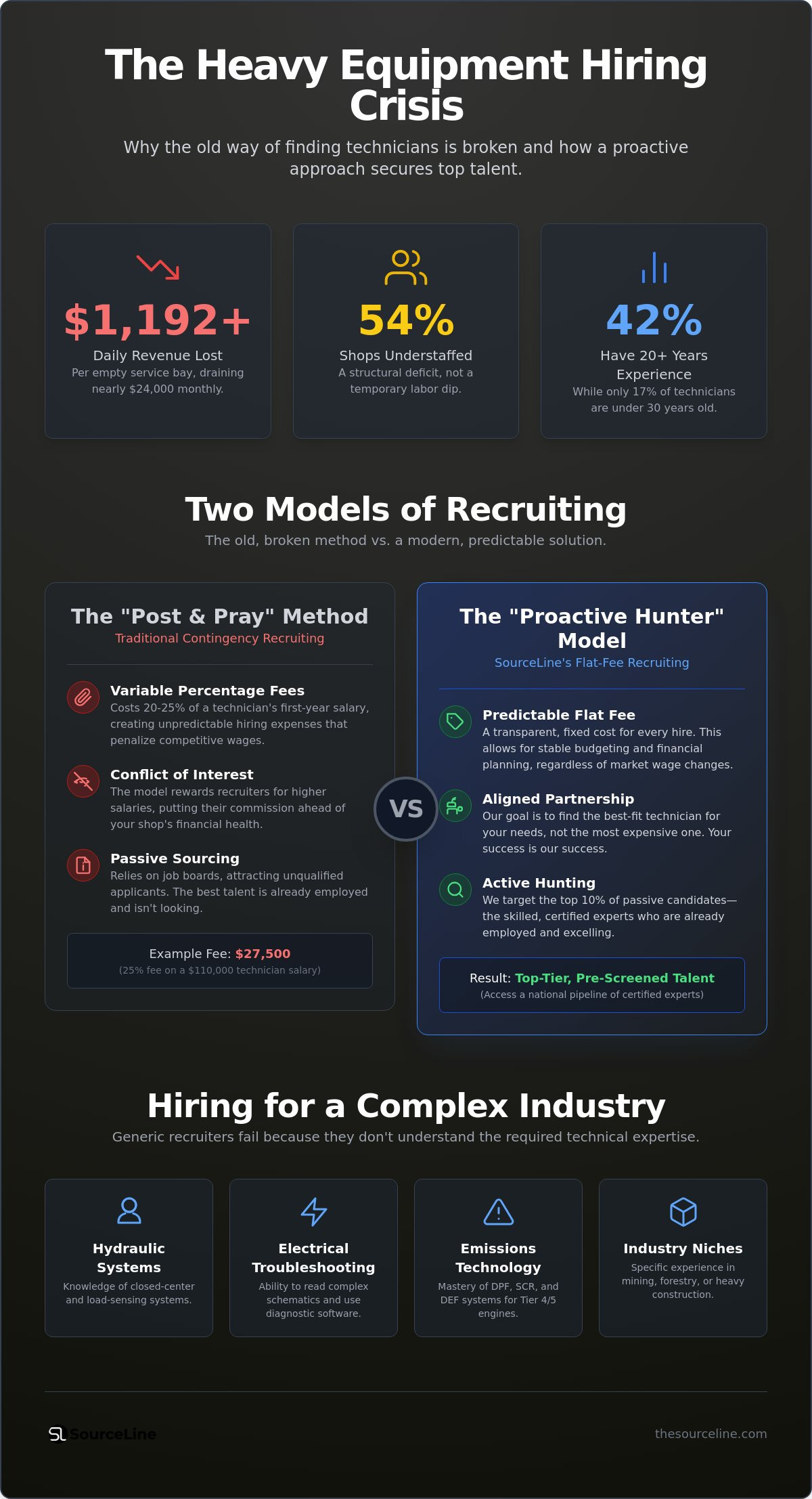
The heavy equipment industry faces a structural deficit that's no longer a future prediction; it's a current operational reality. By mid-2026, 54% of heavy-duty repair shops reported being understaffed. This isn't a temporary dip in the labor market. It's a fundamental shift caused by an aging workforce where 42% of technicians have over 20 years of experience, while only 17% of the workforce is under the age of 30. This demographic cliff makes the role of specialized heavy equipment mechanic headhunters essential for any fleet or dealership that plans to stay profitable.
When a bay sits empty, the financial bleed is immediate. With median shop labor rates reaching $149 per hour, a single vacancy costs your business roughly $1,192 in lost billable revenue every day. Over a standard month, that's nearly $24,000 in unearned income per technician. These figures don't even include the indirect costs of project delays, equipment downtime, or the burnout of your remaining crew who have to pick up the slack. Beyond staffing, minimizing downtime often requires fast parts delivery; you can learn more about SpeedLink Transport Limited to see how express logistics keep essential machinery moving. In this environment, you aren't just "hiring" to fill a seat; you're competing for the top 10% of talent that keeps your operations from grinding to a halt.
Why Job Ads No Longer Produce Qualified Mechanics
The days of finding a lead technician through a generic job board are over. Platforms like Indeed have become a black hole for shop managers, often yielding dozens of resumes from unqualified applicants who lack the basic mechanical foundations required for heavy diesel work. The reality is that the most talented mechanics aren't looking at job boards because they're already working. They're well-compensated, respected by their current employers, and completely invisible to traditional advertising. Passive candidate sourcing has become the industry standard for 2026 because the most reliable talent is already employed and needs to be "hunted" rather than invited to apply.
The Impact of Specialized Machinery on Hiring
A skilled tradesperson in the heavy equipment sector requires a vastly different expertise than an automotive mechanic. Modern machinery is a complex ecosystem of high-pressure hydraulics, advanced electrical systems, and sensitive Tier 4 and Tier 5 emissions technology. Generic heavy equipment mechanic headhunters often fail because they don't understand these technical nuances. They might send you a candidate with basic engine experience when you actually need someone who can troubleshoot a CAN bus failure on a 100-ton excavator or calibrate the GPS-guided blade on a high-spec dozer. Without industry-specific screening, you'll continue to waste time interviewing "parts changers" when you actually need a diagnostic expert.
Hydraulic Systems: Requires deep knowledge of closed-center and load-sensing systems.
Electrical Troubleshooting: Must be able to read complex schematics and use diagnostic software.
Emissions Tech: Mastery of DPF, SCR, and DEF systems is non-negotiable in 2026.
Industry Specifics: Screening for niche experience in mining, forestry, or heavy construction.
Why Traditional Contingency Recruiting is Broken for Heavy Equipment
Traditional recruiting models are fundamentally misaligned with the needs of a modern service department. Most heavy equipment mechanic headhunters still rely on contingency-based fees, meaning they only get paid if they place a candidate. While that sounds low-risk, it creates a "speed over quality" race. Recruiters rush to send the first available resume rather than the best one, hoping to beat out other agencies. This leads to a flood of unqualified applicants that you have to filter yourself, which is exactly why many companies are moving away from traditional heavy equipment mechanic headhunters in favor of more transparent models.
The financial structure of contingency is even more problematic. Traditional firms typically charge 20% to 25% of the technician's first-year salary. For a lead field technician earning $110,000, that's a $27,500 fee for a single hire. This "salary penalty" actually discourages you from offering competitive wages because every dollar you add to the technician's pay increases the recruiter's commission. It's a clear conflict of interest that puts the agency's profit ahead of your shop's bottom line.
The Percentage-Based Fee Trap
When your hiring costs are tied to fluctuating wages, budgeting becomes impossible. If the market rate for a journeyman mechanic spikes, your recruiting expenses follow suit. This volatility makes it incredibly difficult to scale large fleets or plan for annual expansion. According to the BLS Job Outlook for Equipment Technicians, the demand for these roles continues to grow, which will only push salaries and contingency fees higher. A flat-fee model eliminates this "black box" pricing, providing a predictable ROI that allows you to reinvest in your shop rather than in recruiter commissions.
Temporary Staffing vs. Permanent Placement
Many generic agencies try to push a "temp-to-hire" model. In highly skilled technical trades, this is a recipe for disaster. Top-tier mechanics aren't looking for temporary gigs; they want stability, benefits, and a long-term home. Bringing in temporary labor often results in lower morale and higher turnover, which disrupts your shop's rhythm. SourceLine explicitly avoids temporary staffing because we believe that long-term retention is the only way to achieve service department stability. If you're tired of the revolving door, it might be time to explore a more sustainable recruiting strategy that prioritizes permanent talent over quick fixes.
The Proactive Hunter Model: How We Find the Top 10%
Database-driven recruiting is a passive game. It relies on candidates who are already unhappy, unemployed, or browsing job boards. To secure the top 10% of technicians, you need heavy equipment mechanic headhunters who don't wait for applications to arrive. Our methodology shifts the focus from "farming" a stagnant database to "hunting" for high performers who are currently turning wrenches for your competitors. These individuals aren't looking for work, but they are often open to the right career move when approached with professional directness and industry knowledge.
Our 20-year industry advantage allows us to speak the language of a lead technician. We don't just understand job titles; we understand the difference between a shop hand and a diagnostic expert who can rebuild a transmission in the field. This expertise is backed by a nationwide reach. We source talent across the United States, allowing us to pull specialized mechanics from different markets to fill roles in regions where the local talent pool is exhausted. Geography shouldn't be the limiting factor in your shop's capacity.
Vetting for Technical Mastery
Generic recruiting firms often struggle to verify technical claims. We solve this through a rigorous pre-screening protocol that targets specific OEM experience. Whether your fleet relies on Caterpillar, Komatsu, John Deere, or Volvo, we vet for brand-specific knowledge and diagnostic capabilities. We look beyond the resume to confirm expertise in:
Hydraulic Troubleshooting: Ability to diagnose complex pump and valve failures.
Advanced Electronics: Proficiency with proprietary OEM diagnostic software and CAN bus systems.
Certifications: Verifying CDL-A requirements for field service roles and specialized emissions training.
Tool Sets: Ensuring the candidate possesses the professional-grade tools required for heavy-duty work.
The Art of the Passive Candidate Reach-Out
The best mechanics are usually the ones currently being treated well by their employers. Engaging these individuals requires a level of nuance that traditional heavy equipment mechanic headhunters lack. We approach these passive candidates as peers, presenting your opportunity as a logical next step in their career rather than just another job. This proactive engagement is the only way to access the elite tier of the workforce in 2026. The SourceLine prescreen serves as a high-precision filter for both cultural and technical fit, ensuring that every candidate you meet is already qualified for the role and aligned with your shop's values.
The Economics of Flat-Fee Recruiting in 2026
Predictability is a rare commodity in the current labor market. Most heavy equipment mechanic headhunters operate on a percentage of the hire's first-year salary, which makes your recruiting budget a moving target. If you need to hire three lead technicians in a single quarter, your costs could fluctuate by tens of thousands of dollars based solely on the final wage negotiations. A flat-fee model changes the math entirely. It provides a fixed cost per hire, allowing dealerships and fleet managers to forecast their growth expenses with total accuracy. You know exactly what the investment is before the search even begins.
Traditional contingency firms create what we call a "salary penalty." Because their commission is tied to the technician's pay, they are financially incentivized to push for the highest possible starting wage. This puts the recruiter and the employer on opposite sides of the negotiation table. By removing the percentage-based commission, a flat-fee partnership aligns everyone's interests. The goal becomes finding the right technical fit at a sustainable market rate, not inflating the payroll to pad a recruiter's pocket. This transparency is essential for maintaining healthy margins in a high-overhead industry.
Comparing Flat Fee vs. Contingency ROI
Consider a senior field technician earning $45 per hour. In a traditional 25% contingency model, the placement fee would exceed $23,400 for that single hire. When you scale this across a large service department, the costs become astronomical. Flat-fee models offer significant savings by decoupling the recruiting service from the candidate's salary. This approach encourages a long-term partnership rather than a one-off transaction. You aren't just buying a resume; you're investing in a scalable sourcing engine that becomes more cost-effective as your fleet grows. The savings realized from just two or three hires can often fund an entire year of proactive talent pipelining.
Eliminating Hidden Costs and Staffing Fluff
Many heavy equipment mechanic headhunters bake high administrative overhead and marketing fluff into their percentage fees. You end up paying for their corporate infrastructure rather than the actual work of finding a mechanic. We focus strictly on the high-value tasks: aggressive sourcing and technical screening. This reduces the internal HR burden for fleet managers, who no longer have to sift through dozens of unqualified applications from generic job boards. Our transparent billing structure is simple, honest, and designed for businesses that value results over process. If you're ready to stop overpaying for talent, explore the ROI of our flat-fee recruiting model.
Partnering with SourceLine: Your National Search Firm
Building a high-performing service department requires more than just a stack of resumes. It requires a partner who understands the difference between a general mechanic and a specialized technician. We begin every engagement with a comprehensive fleet needs assessment. This initial consultation allows us to understand your specific equipment mix, shop culture, and long-term growth objectives. By identifying the exact technical gaps in your team, our heavy equipment mechanic headhunters can target the specific talent your shop needs to increase billable hours.
Our commitment to the heavy equipment, construction, and heavy truck industries is rooted in over 20 years of industry experience. We don't just search for candidates; we represent your brand to the most sought-after professionals in the country. In a market where the best technicians have their pick of employers, professional headhunting positions your dealership as the employer of choice. We communicate your value proposition with the technical accuracy that elite mechanics respect, ensuring that your open roles stand out in a crowded market.
Our Industry-Specific Specialization
While we excel in the heavy machinery sector, our expertise extends across the entire spectrum of specialized technical trades. We provide nationwide sourcing for the RV, Marine, and Powersports industries. Our heavy equipment mechanic headhunters leverage this nationwide coverage to find niche technical talent that local ads simply can't reach. This cross-sector knowledge gives us a unique advantage. We understand the common mechanical foundations while respecting the unique certifications required for each niche. Whether you're looking for a master marine technician or a lead construction equipment mechanic, you're working with recruiters who speak the language of the trades and understand the operational pressures of a busy service bay.
Next Steps: Securing Your 2026 Workforce
The transition to a proactive hiring model is seamless. Once we've established your requirements, our team begins the hunt immediately. You can expect to see the first round of prescreened, qualified candidates within a few weeks of our initial engagement. We integrate directly with your existing hiring process, handling the heavy lifting of sourcing and initial vetting so your service managers can focus on the final interviews. It's time to stop reacting to vacancies and start building a pipeline of elite talent. Scale your fleet with SourceLine's flat-fee recruiting services.
Secure Your Shop's Future with Proactive Sourcing
The 2026 technician shortage isn't going away, but your empty service bays can. We've shown that relying on passive job boards and expensive contingency recruiters only drains your revenue and inflates your payroll. To win in this market, you need a partner that actively hunts for the top 10% of talent using a model built for transparency. By switching to a flat-fee structure, you eliminate the salary penalty and gain a predictable hiring cost that scales with your fleet. This approach ensures your recruiting budget is an investment in growth, not a fluctuating expense.
Our team at SourceLine brings over 20 years of specialized industry experience to every search. We don't just wait for applications; we leverage a nationwide sourcing network to find the diagnostic experts your shop requires. Working with specialized heavy equipment mechanic headhunters means you get candidates who are already vetted for technical mastery and cultural fit. For organizations that need help managing these new hires and overall workforce compliance, Sullivan Group HR offers professional outsourcing solutions to streamline your back-office operations. It's time to stop overpaying for recruiting and start investing in the technicians who keep your operations profitable. Our flat-fee model saves thousands over traditional headhunters while delivering the elite talent your fleet demands.
Stop losing revenue to empty bays-Contact SourceLine for Flat-Fee Recruiting
Your shop deserves a full crew of elite mechanics. Let's get to work and get those bays filled.
Frequently Asked Questions
How much do heavy equipment mechanic headhunters typically charge?
Most traditional firms charge a contingency fee between 20% and 30% of the candidate's first-year salary. This model means the recruiter's commission increases as the technician's wage goes up. SourceLine operates on a transparent, flat-fee model instead. This approach provides a fixed cost for every hire, making your recruiting budget predictable and removing the conflict of interest found in percentage-based pricing.
What is the difference between flat-fee and contingency recruiting?
Contingency recruiting is a "post and pray" model where you only pay if a hire is made, but the fees are often high and variable. It encourages recruiters to rush through resumes to beat competitors. Flat-fee recruiting is a proactive service where you pay a set price for specialized sourcing and vetting. It aligns the recruiter's goals with your shop's bottom line rather than the technician's final salary.
Do you recruit for heavy equipment dealerships nationwide?
Yes, we provide nationwide search services across the United States. Our heavy equipment mechanic headhunters aren't restricted by local talent pools. We have the reach to source elite technicians from different regions and relocate them to your market. This is essential for dealerships in areas where local specialized labor has been completely exhausted.
How do you screen mechanics for technical proficiency?
Our screening process targets specific OEM experience and diagnostic capabilities. We don't just look at job titles; we verify knowledge of hydraulic systems, advanced electronics, and emissions technology. We also ensure candidates have the professional tool sets and CDL-A certifications required for field service. This ensures every candidate we present is ready to be productive on day one.
Why is it so hard to find heavy equipment technicians in 2026?
The industry is facing a structural shortage caused by an aging workforce. Roughly 42% of current technicians have over 20 years of experience, while only 17% of the workforce is under age 30. This demographic cliff means the most skilled mechanics are already employed and well-compensated. They aren't looking at job boards, so they must be proactively hunted by specialists.
Does SourceLine provide temporary staffing services?
No, we do not offer temporary staffing or "temp-to-hire" placements. We believe that shop stability depends on permanent, long-term talent. Skilled technicians in the heavy equipment sector want the security of a full-time role with benefits. Our model is designed to find career-minded professionals who will stay with your dealership for the long haul.
What industries besides heavy equipment does SourceLine serve?
We specialize in several niche technical sectors including RV, Marine, Powersports, and Heavy Trucking. Our expertise is rooted in any industry that requires high-level mechanical and diagnostic skills. This broad experience across the trades allows us to identify transferable skills that other heavy equipment mechanic headhunters might miss during the sourcing process.
Can you help find service managers and leadership for heavy machinery fleets?
Yes, we actively source for leadership roles such as service managers, shop foremen, and parts department heads. A shop's efficiency depends on its management as much as its technicians. We use the same proactive "hunter" methodology to find experienced leaders who understand the operational pressures of the heavy equipment industry.


Comments