.png)
Hiring Heavy Equipment Technicians: The 2026 Employer’s Checklist
Updated: Jul 31
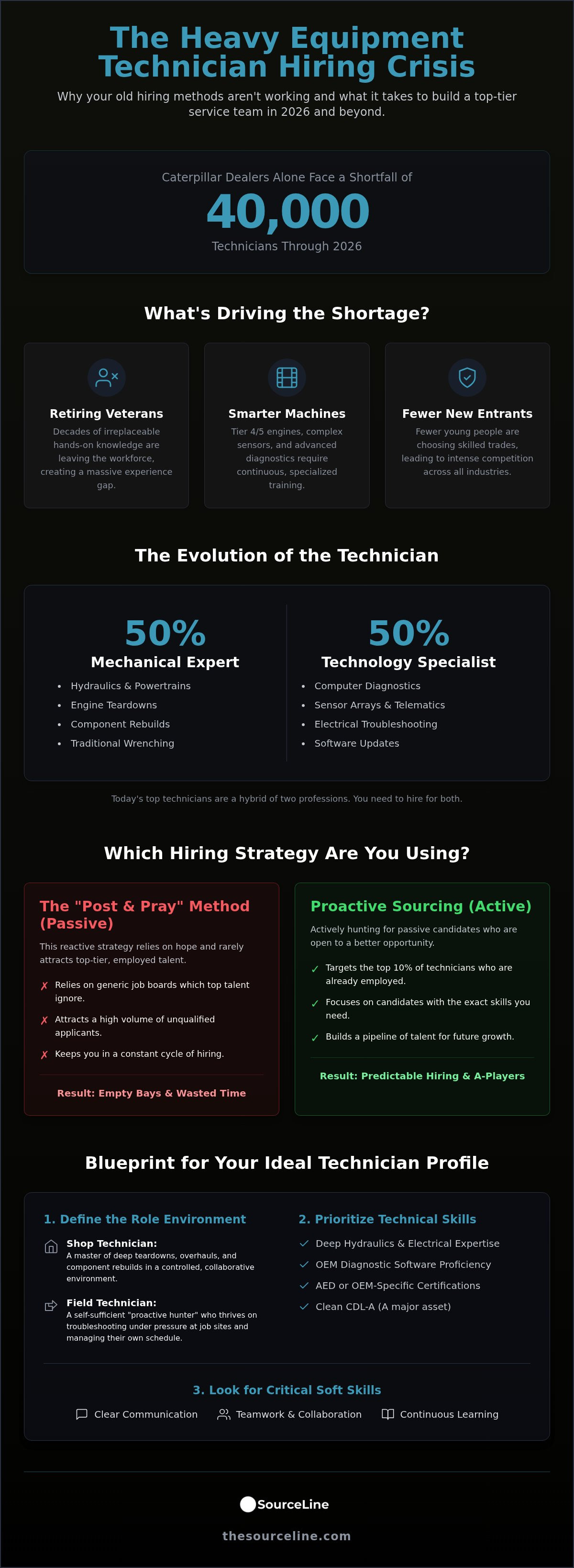
Caterpillar dealers alone are facing a shortage of 40,000 technicians through 2026. This isn't just a tight market. It's a crisis that makes hiring heavy equipment technicians feel nearly impossible. When machines sit idle, you're losing revenue every hour the shop stays quiet.
You likely know the frustration of dealing with high turnover or paying massive recruiter fees that eat your margins. Dealing with empty bays is a drain on your energy and your bottom line. You need skilled mechanics who show up and stay, but the traditional ways of finding them aren't working anymore.
There is a better way to find the top 10% of talent without the usual headaches. I'll show you how a proactive sourcing strategy can help you find the right people while saving your budget. This checklist covers everything you need to create a predictable hiring process and lower your cost-per-hire for good.
Table of Contents
The State of Hiring Heavy Equipment Technicians in 2026
The industry is hitting a wall. For years, shop owners could find a local mechanic through word of mouth or a simple help-wanted sign. In 2026, those days are gone. Caterpillar dealers alone report a shortage of 40,000 technicians. This gap is widening as the most experienced veterans retire, taking decades of knowledge with them. When these experts leave, they often leave a hole in the service department that a single entry-level hire cannot fill.
The job itself has changed. Modern heavy equipment mechanics are no longer just turning wrenches. They are 50% mechanical experts and 50% technology specialists. If you are hiring heavy equipment technicians today, you aren't just looking for someone who knows hydraulics. You need someone who can navigate complex computer diagnostics and sensor arrays. The talent pool hasn't kept pace with how fast the machines have evolved.
Why the Talent Gap is Growing
The machines are getting smarter, but the labor pool is getting smaller. Tier 4 and Tier 5 engines brought a level of complexity that requires constant, specialized training. Many shops are struggling to keep up with the diagnostic tools and software updates needed for these systems. It takes more than basic tools to fix a modern excavator.
At the same time, fewer young people are entering the trades. We are seeing a massive shift where high schools push four-year degrees over technical certifications. This leaves your service department competing for a tiny slice of the workforce. You aren't just competing with the shop down the street. You are fighting for talent against the heavy truck, marine, and construction sectors. Every industry needs skilled hands right now.
The Problem with Passive Recruiting
Most employers stay in a "post and pray" cycle. They put an ad on a job board and hope the right person sees it. This is a passive strategy that rarely works for high-level roles. The top 10% of technicians are almost never looking at job boards. They are already working, usually for your competitors, and they are being treated well.
Generic job postings often attract candidates who lack the right certifications or experience. This wastes your time and keeps your bays empty. To win in 2026, you must use proactive sourcing. Proactive sourcing is the act of finding "passive" candidates who aren't looking for a job but are open to a better opportunity. If you want to grow, you have to stop waiting for people to find you and start hunting for them yourself.
Defining Your Ideal Heavy Equipment Technician Profile
You cannot find the right person if you don't have a clear blueprint. Hiring a "general mechanic" is a mistake that often leads to a skill mismatch and early turnover. Start by looking at your yard and identifying the specific machinery your shop services most often. A technician who is a master with John Deere equipment might struggle with the specific computer systems used by Komatsu or Case. You need someone whose experience aligns with your fleet's specific diagnostic software and hydraulic layouts. If you are also looking to optimize your equipment acquisition strategy, you can discover Nortruck Forklifts for professional guidance on sourcing reliable lifting machinery.
The next step is deciding between a shop-based mechanic and a field service technician. These roles require different mindsets. Shop roles usually focus on deep teardowns, major overhauls, and component rebuilds in a controlled environment. Field roles require a "proactive hunter" mentality. These technicians must be able to troubleshoot in the mud, handle the pressure of a downed machine on a job site, and manage their own schedule without a shop foreman looking over their shoulder.
According to the Job Outlook for Heavy Equipment Technicians, there are about 21,700 openings projected each year through 2034. With so much competition, you cannot afford to hire the wrong person and start over. If you're struggling to pin down exactly what your shop needs, working with a specialized heavy equipment recruiting partner can help you define the role and find candidates who actually fit your profile.
Technical Skills and Certifications
Prioritize candidates with deep experience in hydraulics and electrical troubleshooting. General wrenching is a baseline, but the real value in 2026 is in the diagnostic work. Look for certifications from the Associated Equipment Distributors (AED) or specific OEM training from brands like Deere, CAT, or Case. If your technicians need to move machinery between sites, a clean CDL-A is a massive asset. It saves you from waiting on a dedicated driver every time a machine needs to go back to the shop.
Cultural Fit and Soft Skills
A field technician is the face of your company. They need to communicate clearly with operators and site managers to explain the "why" behind a failure. In the shop, teamwork is the priority. You need people who share tools and knowledge without ego. Look for a willingness to participate in ongoing technical education. Because machine technology is evolving so fast, a technician who stops learning will be obsolete within a few years. You want someone who is as comfortable with a laptop as they are with a torque wrench.
Recruitment Models: Flat-Fee vs. Contingency
Choosing the right partner for hiring heavy equipment technicians often comes down to the math. Most traditional contingency firms charge between 20% and 30% of a technician’s first-year salary. If you hire a senior field tech at $85,000, you could be looking at a $25,000 bill just for the placement. This model creates an inherent conflict of interest. The recruiter is often incentivized to push for the highest possible salary because it directly increases their commission check.
Flat-fee recruiting changes the dynamic. Instead of a percentage, you pay a predictable, fixed cost for the work of finding and vetting the talent. This model focuses on the process of the hunt rather than the final paycheck. It allows for a more transparent relationship where the recruiter’s only goal is to find the best fit for your shop. You get the same proactive sourcing without the budget-breaking surprises that come with percentage-based fees.
The Hidden Costs of Contingency Hiring
High placement fees do more than just hurt your bank account. They eat directly into your service department’s annual profit margins. When you pay a massive fee, the technician needs to work for months just to cover the cost of their own hire. This puts immediate pressure on the shop to generate billable hours to make up the loss. Unlike pay-per-click job boards where costs can spiral without a guaranteed placement, flat-fee recruiting provides total cost certainty.
There is also the "speed over quality" trap. Contingency recruiters often use a "throw everything at the wall" approach. They want to be the first to send a resume so they can claim the fee. This leads to high turnover later because the candidate wasn't properly vetted for your specific shop culture or technical needs. Learn more about our flat-fee pricing model to see how we avoid these pitfalls.
Why Flat-Fee Sourcing Wins
Flat-fee sourcing is about paying for the actual work of finding talent. The job outlook for heavy equipment technicians is extremely competitive. Finding the top 10% requires a dedicated effort that goes beyond job boards. With a flat fee, you are hiring a partner who spends their time digging into the market to find the technicians who aren't even looking for a new role.
This approach ensures you only talk to the best when hiring heavy equipment technicians. At SourceLine, we focus on deep prescreening to make sure every candidate meets your technical standards before they ever reach your desk. For a deeper look at how this works, read our guide on Heavy Equipment Mechanic Headhunters. It’s a more honest way to build a team that stays long-term.
The Ultimate Heavy Equipment Hiring Checklist
Effective hiring heavy equipment technicians requires more than just posting an ad. You need a repeatable system that filters out unqualified candidates and identifies the top 10% of talent. If you aren't seeing the results you want, your process for hiring heavy equipment technicians likely needs a refresh. This checklist ensures you cover every detail from the first job post to the technician's first day in the shop.
Step 1: The Job Description and Pay
Most job postings are boring lists of duties. To stand out, you must highlight your unique shop culture and the specific equipment brands you service, such as CAT, Deere, or Case. Be specific about the work environment. Mention if they'll be doing deep teardowns in a climate-controlled shop or troubleshooting in the mud. Set a competitive pay and benefits package based on national market intelligence. Technicians know their worth in 2026. If your offer isn't aligned with current market rates, the best talent won't even apply.
Step 2: Screening and Interviewing
A resume only tells part of the story. Use technical assessments to verify knowledge of hydraulics and electronics. Ask behavioral questions to understand how they handle high-pressure repairs on a busy job site. For instance, ask them to describe a time they had to diagnose a complex failure without a service manual. Your service manager should always be involved in the final interview. They can spot a lack of technical expertise that a general recruiter might miss. Don't forget to conduct thorough background checks and verify every certification, including AED or specialized manufacturer training.
Step 3: Making the Offer and Onboarding
Top talent is usually off the market in a matter of days. When you find the right person, move quickly to avoid losing them to a competitor. Clearly outline the benefits, including tool allowances and continuing education. Once they sign, your work isn't done. A structured onboarding process is essential for long-term success. It helps the new hire feel like part of the team and ensures they understand your shop's specific safety and operational protocols. Mechanics who feel supported from day one are much more likely to stay for the long haul.
Scaling Your Fleet with a Strategic Recruiting Partner
Scaling a fleet in 2026 is a math problem that requires a human solution. If you rely on local job boards, you're fighting for the same small slice of active job seekers as everyone else. Partnering with a niche firm like SourceLine changes the game. We give you access to a national network of talent that most shops can't reach on their own.
Our team acts as proactive hunters. We don't wait for a technician to have a bad day and look at a job board. We find the high-quality mechanics who are currently working and show them why your shop is a better move. We handle the heavy lifting of sourcing and prescreening so you only talk to the best. This process lets you stay focused on running your shop while we keep your pipeline full.
It's a more efficient way of hiring heavy equipment technicians that actually respects your time. You won't have to sift through dozens of unqualified resumes or chase down candidates who don't call back. We provide the market intelligence and the reach you need to grow your service department with confidence. This allows you to move from reacting to empty bays to building a deep bench of skilled hands.
Industry-Specific Expertise
You shouldn't have to explain what a Tier 4 engine is to your recruiter. We speak the language of heavy equipment, construction, and heavy trucks every day. Our team knows the difference between a parts changer and a true diagnostic expert. We understand that a field service tech needs a different temperament than a shop mechanic. Explore our heavy equipment recruiting services to see the difference specialized expertise makes.
The SourceLine Advantage
Most recruiting models are broken. Percentage-based firms are expensive and often lead to rushed hires that don't last. We offer a model built specifically for the trades. We deliver high-quality candidates at a fraction of the cost of contingency firms. This creates a predictable way to grow your team without the financial stress that comes with traditional headhunters.
Our flat-fee approach ensures our interests are perfectly aligned with yours. We aren't trying to inflate a salary to get a bigger commission check. We want to find the right person for your shop at a price that makes sense for your budget. Take the next step and contact us to start your search for hiring heavy equipment technicians.
Build a Service Department That Outlasts the Competition
The technician shortage isn't going away, but your empty bays can. By moving from passive job boards to a proactive hunting strategy, you can find the mechanics who keep your fleet moving. Focus on technical diagnostics and cultural fit rather than just a list of years on a resume. Taking a proactive approach to hiring heavy equipment technicians is the only way to stay ahead in 2026.
You don't have to navigate this market alone. SourceLine brings over 20 years of trade recruiting experience and nationwide sourcing capabilities to your shop. Our specialized flat-fee model ensures you get top-tier talent without the unpredictable costs of traditional firms. We handle the technical vetting so you can focus on your customers and your bottom line.
It's time to stop reacting to turnover and start building a team that stays. Your business deserves skilled hands and a predictable hiring process. We are ready to help you get there.
Frequently Asked Questions
How much does it cost to hire a heavy equipment technician through an agency?
Traditional agencies often charge a percentage of the candidate's first-year salary, which typically ranges from 15% to 25%. For a senior technician earning $80,000, this could mean a fee of $20,000 or more. Some specialized firms use a flat-fee model instead. This approach provides total cost certainty because you pay a fixed price for the sourcing work regardless of the technician's final pay rate.
What is the difference between a flat-fee recruiter and a contingency firm?
Contingency firms only get paid if they place a candidate, which often leads them to prioritize speed over long-term fit. They charge a percentage of the final salary. A flat-fee recruiter charges a set amount for the actual work of finding and vetting talent. This model aligns the recruiter's interests with yours because they aren't trying to drive up the salary to earn a higher commission check.
How long does it typically take to find a qualified diesel mechanic?
Finding a qualified technician usually takes between 30 and 60 days in the current market. This timeline depends on your location and the specific certifications you require. If you use a proactive sourcing strategy, you can often shorten this window by reaching out to passive candidates who aren't looking at ads. Waiting for the right person to find your job post can take much longer.
Can I hire heavy equipment technicians from other states?
You absolutely can and should look nationwide when hiring heavy equipment technicians. Many top-tier mechanics are willing to relocate for the right opportunity, especially if you offer a relocation package. Expanding your search beyond your local area is often the only way to find specialized skills for Tier 4 or Tier 5 engine diagnostics in a tight labor market.
What certifications should I look for in a heavy equipment mechanic?
Look for certifications from the Associated Equipment Distributors (AED) or ASE T-series for medium and heavy trucks. Specialized OEM training from brands like John Deere, Caterpillar, or Komatsu is also a high-value indicator. If the role involves field service, a CDL-A is often necessary. These credentials prove the technician has the technical foundation to handle modern, computer-controlled machinery.
How do I improve technician retention in my service department?
Retention starts with a competitive tool allowance and a clean, well-organized work environment. Technicians also value a clear path for career growth and access to the latest diagnostic software. If you invest in their continuing education, they feel more valued and are less likely to leave for a competitor. Providing a predictable schedule and a positive shop culture are also essential for long-term loyalty.
Why are job boards failing to provide qualified heavy equipment candidates?
Job boards only reach active job seekers who are currently unemployed or unhappy. The most skilled technicians are already working and aren't scrolling through ads. To find the top 10% of talent, you need a proactive hunter who can identify and approach these candidates directly. hiring heavy equipment technicians effectively requires going where the talent is, rather than waiting for them to come to you.
What should be included in a heavy equipment technician job description?
Your job description should highlight your shop's culture and the specific brands you service, such as CAT or Deere. Mention the ratio of diagnostic work to mechanical repairs so candidates know what to expect. Be clear about the benefits, such as health insurance, retirement plans, and tool stipends. Simple, direct language works best to capture the attention of busy professionals who value transparency and honesty.


Comments