.png)
Recruiting for Powersports Dealers: A 2026 Hiring Readiness Checklist
- SourceLine
- 11 hours ago
- 11 min read
Table of Contents
The Current State of Recruiting for Powersports Dealers
The powersports industry is growing fast. More people are buying ATVs, UTVs, and motorcycles. This growth creates a huge demand for skilled technicians, but the supply of qualified talent is not keeping up. Dealerships across the country face a severe labor shortage, leaving service bays empty and customers waiting.
Many dealers struggle to find technicians who can handle modern powersports vehicles. Today’s machines are complex. They rely on advanced EFI systems, CAN bus networks, and sophisticated electronics. The old-school mechanic who only knows carburetors is no longer enough. You need technicians with diagnostic skills and a deep understanding of today's technology.
Unfortunately, traditional hiring methods are failing. Posting a job on a public board often results in a flood of low-quality applicants. Most lack the specialized training your shop needs. Success in 2026 requires a proactive approach. You can no longer afford to wait for the right person to find you. You have to go out and find them.
Why Traditional Job Boards Fail Dealers
Top-tier technicians are not scrolling through job ads. The best mechanics are already employed and are usually happy where they are. They are not actively looking for a new job. These are known as "passive candidates," and they represent the most valuable talent pool in the industry.
Passive candidates are not desperate for work. They are confident in their skills and will only move for a significantly better opportunity. To reach them, you need a targeted strategy that goes beyond a simple job post. This requires actively searching for and engaging with talent that is not looking.
Relying on job boards also creates a huge time drain. Your service manager ends up sifting through dozens of unqualified resumes instead of running the shop. This administrative burden costs you money and pulls your leadership away from revenue-generating tasks. The time spent filtering out bad applicants is time that could be spent improving shop efficiency and customer satisfaction.
The Impact of the Technician Shortage on Revenue
Empty service bays have a direct impact on your bottom line. Every unfilled spot represents lost labor revenue. When you are understaffed, lead times for service and repairs get longer. Customers get frustrated and take their business elsewhere, often to a competitor who can get the work done faster.
Hiring an unqualified technician out of desperation is even worse. A poorly trained mechanic can lead to costly comebacks. Incorrect diagnoses and sloppy repairs damage your dealership's reputation and destroy customer trust. A single comeback can wipe out the profit from several successful jobs.
The shortage also forces service managers to pick up the tools. When your leader is stuck working in a bay, they are not managing shop flow, mentoring junior techs, or handling customer issues. This creates a leadership vacuum that reduces overall productivity and hurts team morale.
Critical Roles Every Powersports Dealership Needs
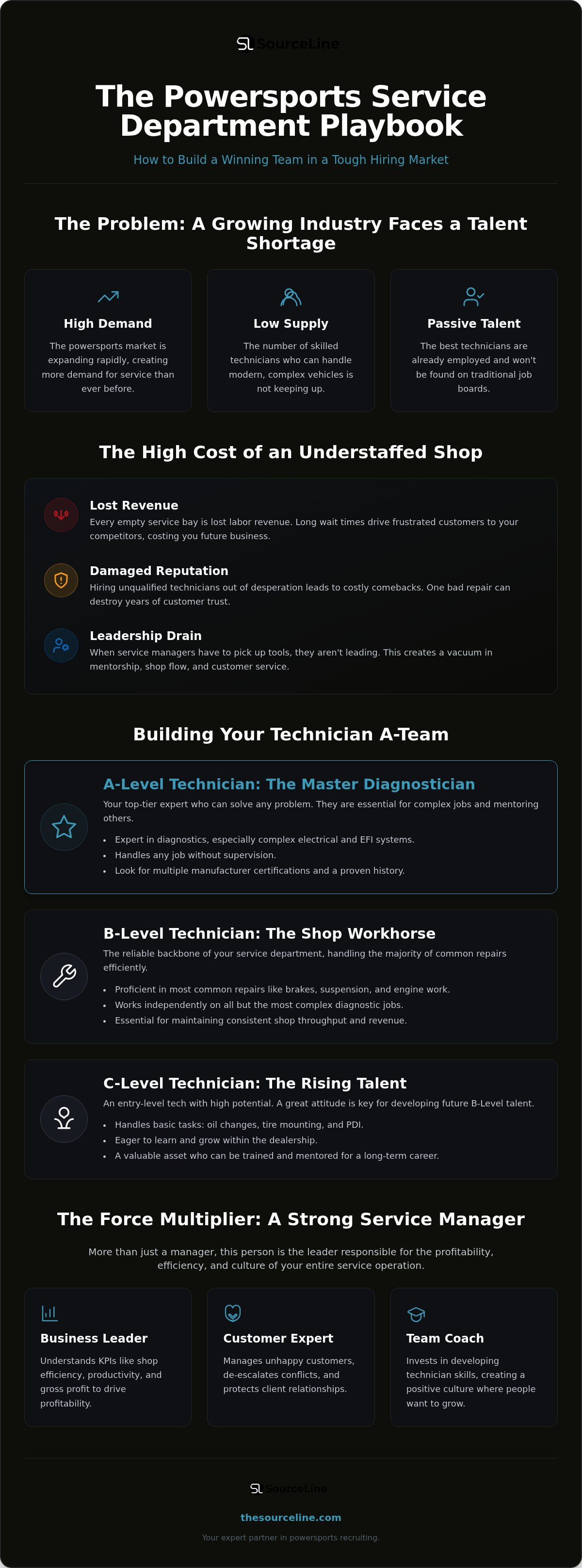
A profitable dealership is built on a balanced team. You need a mix of technical experts in the service bay and strong leaders in management roles. Without this balance, your service department will struggle to grow and remain profitable. It all starts with understanding the different skill levels required to run a modern shop.
There is a big difference between a "parts changer" and a true diagnostic technician. A parts changer follows a flowchart and replaces components until the problem goes away. A diagnostic tech understands the underlying systems and can pinpoint the exact cause of a failure. In 2026, you need diagnostic experts to handle complex electronic and fuel system issues.
The service manager is the backbone of your entire service operation. They control the workflow, manage the technicians, and ensure a high level of customer satisfaction. A great service manager is a force multiplier who makes the entire team better. In sales, specialized roles are also becoming more important. Your sales team needs deep product knowledge to effectively sell high-tech vehicles to informed consumers.
Technician Levels and What to Look For
Understanding technician skill levels helps you build a well-rounded team. Each level plays a distinct role in the shop.
A-Level Technicians: These are your master technicians. They are experts in diagnostics, especially with complex electrical and EFI systems. An A-level tech can handle any job that comes through the door without supervision. Look for multiple manufacturer certifications and a proven history of solving difficult problems.
B-Level Technicians: These are your mid-range workhorses. A B-level tech is proficient in most common repairs and maintenance tasks. They may need occasional guidance on highly complex diagnostics but can work independently on brakes, suspension, and engine work. They are essential for maintaining shop throughput.
C-Level Technicians: These are often entry-level techs or lube specialists. They handle basic tasks like oil changes, tire mounting, and PDI (pre-delivery inspection). A C-level tech with a great attitude and a strong work ethic is a valuable asset who can be trained and groomed for a B-level role in the future.
The Importance of a Strong Service Manager
A service manager does more than just assign work orders. They are business leaders responsible for the profitability and efficiency of the service department. When hiring a service manager, look for someone who understands key performance indicators (KPIs) like shop efficiency, productivity, and gross profit.
Your service manager must also be an expert in customer service. They are the front line for handling unhappy customers and resolving conflicts. Look for candidates with experience in de-escalating tense situations and finding solutions that protect both the customer relationship and the dealership's bottom line.
Finally, a great service manager is a mentor and a coach. They should be invested in developing the skills of their technicians. They create a positive shop culture where people want to come to work and do their best. Learn more about how to find the right leaders for your powersports recruiting efforts.
Recruiting Models: Choosing the Right Strategy
When you need to hire, you have a few options. Many dealers turn to traditional recruiting firms that work on a contingency basis. This means you only pay a fee if you hire a candidate they present. While it sounds risk-free, this model has hidden downsides.
Contingency recruiters typically charge a fee that is a percentage of the new hire's first-year salary. This fee can be anywhere from 20% to 30%. This model can create a conflict of interest. The recruiter is financially incentivized to present the most expensive candidate, not necessarily the best fit for your shop. Their goal is to maximize their commission.
An alternative is flat-fee recruiting. In this model, you pay a fixed price for the service, regardless of the candidate's final salary. This removes the incentive to push higher-priced candidates. The focus shifts entirely to finding the right person for the job based on skills, experience, and cultural fit. This approach provides cost predictability and aligns the recruiter's goals with your own.
Understanding the Cost of Contingency
Let's look at a real-world example. If you hire a service manager with a $70,000 annual salary, a 20% contingency fee would cost you $14,000. This is a significant expense that directly impacts your profitability. For many dealerships, these high fees make it difficult to justify using a recruiter for anything other than top-level executive roles.
Traditional staffing models often lack transparency. You may not know how the recruiter found the candidate or how thoroughly they were vetted. Many contingency firms simply pull resumes from the same job boards you already have access to. You end up paying a huge fee for work you could have done yourself. Our guide on flat fee vs. contingency recruiting breaks down the differences in more detail.
The Benefits of a Fixed-Fee Approach
A fixed-fee or flat-fee model makes budgeting for a new hire simple. You know the exact cost of the recruiting service upfront. There are no surprise fees or percentage calculations to worry about. This allows you to plan your expenses with confidence.
With a flat-fee partner, the focus remains on sourcing and prescreening the best possible talent. The recruiter's success is tied to finding a quality candidate who stays with you long-term, not on the size of the placement fee. This shared goal creates a true partnership between your dealership and the recruiting firm.
This model is designed to save you money while delivering high-quality candidates. By removing the percentage-based commission, SourceLine provides specialized flat-fee recruiting that helps you build a winning team without breaking the bank.
The Powersports Dealer Hiring Readiness Checklist
The single biggest mistake dealers make is starting the search for a new hire before they are ready. A reactive, disorganized hiring process repels top talent and leads to bad decisions. To win the war for talent in 2026, your dealership must be "hiring ready." This means having a clear, structured plan in place before you even think about posting a job.
Use this checklist to prepare your dealership. Following these steps will make you a more attractive employer, streamline your interview process, and dramatically increase your chances of making a successful, long-term hire.
Define the Role with Extreme Clarity. Go beyond a generic job description. What specific skills are required? Will this technician need to be an expert on a particular brand like Polaris or Can-Am? What diagnostic software will they use every day? Create a list of "must-have" skills versus "nice-to-have" skills. This clarity will guide your entire search.
Audit Your Shop Environment. The best technicians want to work in a professional environment. Take an honest look at your service department. Is it clean and organized? Is the lighting good? Are your lifts and major equipment well-maintained and safe? Do you provide specialized diagnostic tools, or are techs expected to buy everything themselves? A clean, safe, and well-equipped shop is a powerful recruiting tool.
Prepare a Competitive Compensation Package. Do your research. What is the current market rate for an A-level technician in your area? Your offer needs to be more than just an hourly wage. Consider what benefits you offer, such as health insurance, paid time off, and a retirement plan. Think about adding perks like a tool allowance, a signing bonus, or paid manufacturer training.
Create a Structured Interview Process. A consistent process ensures every candidate is evaluated fairly. Plan your questions in advance. Include technical questions to vet their skills, behavioral questions to assess their problem-solving abilities, and culture-fit questions to see if they will work well with your team. A structured process shows candidates that you are organized and professional.
Establish a Clear Onboarding Plan. The hiring process does not end when the candidate accepts the offer. A strong onboarding plan is critical for retention. How will you integrate the new hire into your team? Who will be their mentor for the first few weeks? Schedule check-ins at the 30, 60, and 90-day marks to provide feedback and address any concerns. A good onboarding experience makes the new employee feel valued from day one.
Preparing Your Shop for Top Talent
A-level technicians have options. They will not work in a dirty, unsafe, or poorly equipped shop. Before you start recruiting, invest in your facility. Make sure your diagnostic equipment is up to date. A tech who is an expert with modern electronics cannot do their job with outdated tools. A professional environment attracts professional technicians.
Review your safety standards. Is your ventilation adequate? Are fire extinguishers easily accessible? A commitment to safety shows your employees that you care about their well-being. Simple things like a clean breakroom and well-maintained restrooms also make a big difference in the daily work experience.
Interviewing for Technical Competence
During the interview, you need to verify a candidate's technical skills. Do not just take their resume at face value. Ask for specific examples of their work. For instance, ask them to describe the most complex diagnostic challenge they have ever faced and how they solved it. Their answer will reveal a lot about their thought process and expertise.
If a candidate claims to have manufacturer certifications, ask to see them. You can often verify these directly through the manufacturer's portal. When checking references, go beyond confirming employment dates. Ask their previous managers about their reliability, their ability to work as part of a team, and their attitude toward complex jobs.
Scaling Your Dealership with a Recruiting Partner
After you have used the checklist to get your dealership "hiring ready," you may still need help finding top-tier candidates. This is where a specialized recruiting partner can be a game-changer. A good recruiter acts as an extension of your own team, handling the time-consuming work of sourcing and screening talent.
Working with a partner allows you to focus on your daily operations. While you are running your business, a dedicated recruiter is actively searching for the technicians and managers you need. They understand the industry and know the difference between a powersports tech and a marine tech. This specialized knowledge is critical for finding the right fit.
SourceLine provides nationwide coverage for powersports recruiting. We help dealers find the talent they need to grow their service departments and increase profitability.
National Sourcing for Niche Roles
Sometimes, the best candidate for your open position does not live in your city. The local talent pool for skilled powersports technicians is often very small. A recruiting partner with a national reach can find qualified candidates across the country who are willing to relocate for the right opportunity.
This requires a "hunter" approach. Instead of passively waiting for applications, we actively identify and engage with top performers who are not looking for a job. This proactive sourcing method is the key to finding the hidden talent that your competitors cannot reach. Our guide to specialized technician sourcing explains this process in more depth.
The SourceLine Difference
We are not a temporary staffing agency. Our entire focus is on finding long-term, permanent placements that help your dealership succeed. We build lasting relationships with our clients and become a trusted partner in their growth.
Our flat-fee model is transparent and predictable. It saves dealers thousands of dollars on every hire compared to traditional percentage-based firms. We believe in providing exceptional value and aligning our success with yours. Discover how we help RV and powersports dealers across the country build stronger teams.
Frequently Asked Questions About Powersports Recruiting
How much do powersports recruiters typically charge?
Recruiting fees vary based on the model. Traditional contingency recruiters charge a percentage of the employee's first-year salary, usually between 20% and 30%. Flat-fee recruiters charge a fixed price for the search, which provides a predictable cost regardless of the final salary.
What is the difference between flat-fee and contingency recruiting?
Contingency recruiting means you only pay if you hire a candidate from the recruiter. The fee is a high percentage of the salary. Flat-fee recruiting involves a fixed cost paid for the service of sourcing and screening candidates. This model often saves money and ensures the recruiter is focused on finding the best fit, not the most expensive one.
How do I find A-level technicians for my dealership?
Finding A-level technicians requires a proactive approach. They are rarely on job boards. The best methods include networking within the industry, building a strong employer brand, and partnering with a specialized recruiter who can conduct a targeted search for passive candidates.
Why is it so hard to hire powersports mechanics right now?
There is a nationwide shortage of skilled technicians across all trades. Many experienced mechanics are retiring, and not enough new people are entering the field. The increasing complexity of modern powersports vehicles also requires a higher skill level, further shrinking the available talent pool.
Does SourceLine help with relocation for new hires?
While SourceLine does not directly manage relocation logistics or payments, we specialize in finding candidates who are open to relocating for the right opportunity. We facilitate the conversation between the dealer and the candidate regarding potential relocation assistance packages.
What certifications should I look for in a powersports technician?
Look for manufacturer-specific certifications from brands like Polaris, BRP (Can-Am), Honda, Yamaha, or Harley-Davidson. Certifications from the Equipment & Engine Training Council (EETC) are also valuable as they demonstrate a standardized level of knowledge in areas like two-stroke and four-stroke engines.
How long does the recruiting process usually take for a dealer?
The timeline can vary greatly depending on the role and location. A typical search for a specialized technician can take anywhere from 30 to 90 days. The process includes defining the role, sourcing candidates, interviewing, and negotiating an offer. Being "hiring ready" can significantly speed up this timeline.
Can a flat-fee recruiter help find a service manager?
Yes. A flat-fee recruiter is an excellent choice for finding a service manager. Because the fee is not tied to the manager's higher salary, the model remains cost-effective. The recruiter can focus on finding a candidate with the right blend of technical knowledge, leadership skills, and business acumen.


Comments