.png)
Marine Industry Specialized Recruiting: Finding Skilled Technicians in 2026
- SourceLine
- 1 day ago
- 12 min read
Paying a recruiter 30 percent of a technician's salary just to receive a stack of unqualified resumes is a losing strategy. You need experts who understand the difference between a marine electrician and a standard house wireman. Effective marine industry specialized recruiting requires a proactive hunter approach rather than just posting on generic job boards.
We know the frustration of high turnover in your service department. It's even worse when you're stuck with exorbitant hiring fees and a slow time-to-hire. You deserve a steady pipeline of skilled marine techs without the budget-breaking costs of traditional staffing agencies. This guide will show you how to navigate the current talent shortage and find the specialized technicians your shop needs.
We will explore how a modern recruitment model provides predictable costs and better results in 2026. You'll learn why deep industry knowledge is the only way to vet candidates for advanced digital systems and mechanical roles. It's time to stop settling for "good enough" and start building a team that actually keeps boats on the water.
Table of Contents
The Growing Need for Marine Industry Specialized Recruiting
Finding a technician who knows their way around a Volvo Penta or a complex NMEA 2000 network is harder than ever. The industry is facing a critical shortage of certified talent. Most dealerships are struggling with a massive service backlog. Customers are waiting weeks for simple repairs. This isn't just a minor inconvenience. It's a threat to your bottom line. Effective marine industry specialized recruiting is the only solution to this growing crisis.
Understanding the Current Marine Labor Market
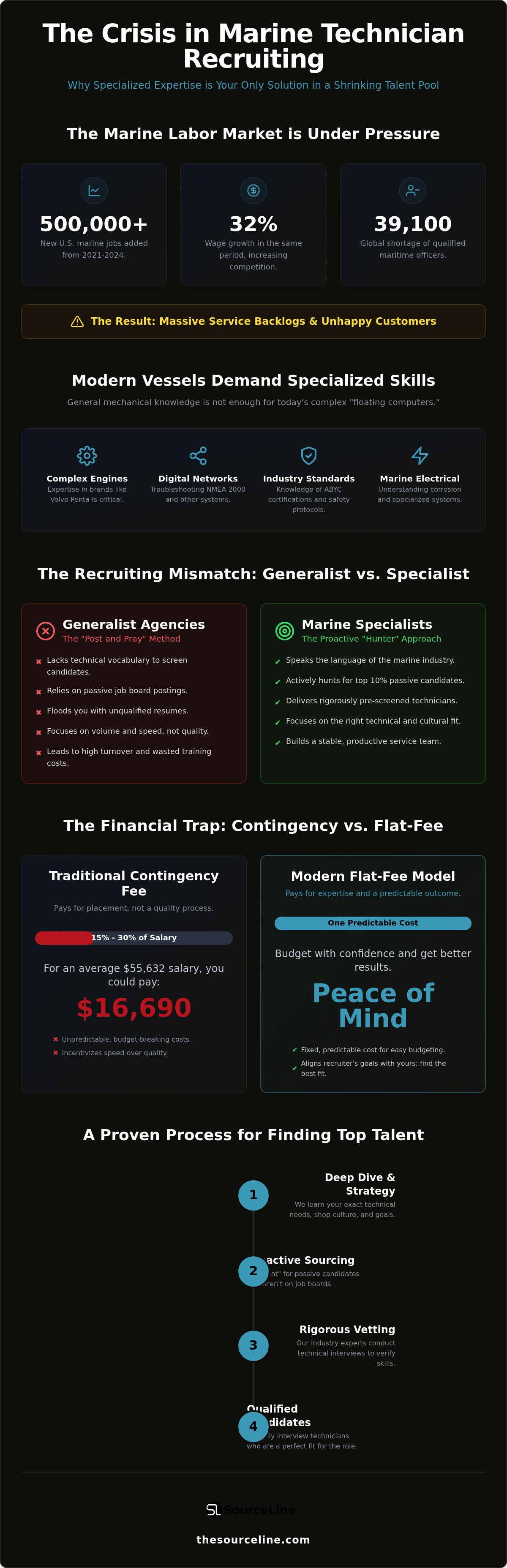
The maritime trades are seeing a massive wave of retirements. Experienced mechanics are leaving the floor. Not enough new techs are entering the pipeline to replace them. This gap is widening as boat sales remain steady. According to NOAA in March 2026, the U.S. marine economy added over 500,000 jobs between 2021 and 2024. Wages grew by 32 percent in that same period.
The history and complexity of shipbuilding shows how much technology has changed over the decades. Modern vessels are essentially floating computers. They require specialized knowledge that goes beyond basic mechanical skills. BIMCO and the International Chamber of Shipping reported a global shortage of 39,100 officers in June 2026, highlighting a massive gap in qualified maritime personnel.
Why Specialized Knowledge Matters in Hiring
A generalist recruiter doesn't know the difference between a car mechanic and a marine technician. They see "engine repair" on a resume and think it's a match. That is a dangerous mistake. Marine environments are harsh. Technicians must understand how corrosion affects electrical systems. They need to know how water intake and exhaust systems work under pressure.
Hiring the wrong person is more expensive than leaving the position vacant. You waste time on training only to watch them struggle with basic marine tasks. High turnover in your service department kills morale and frustrates your best customers. This is why marine industry specialized recruiting is no longer optional. It's the only way to reach the top 10 percent of passive candidates who aren't looking at job boards.
General job boards like Indeed or ZipRecruiter are passive. You post an ad and hope the right person sees it. The best technicians are already working. They don't have time to browse listings. They need a recruiter who can hunt them down and speak their language. A specialized recruiter knows where these people are. They understand the nuances of certifications like ABYC or manufacturer-specific training.
The demand for seafarers is projected to grow by 13 percent through 2027. Average annual salaries for marine technicians have reached approximately $55,632 as of July 2026. Even with higher pay, the talent pool remains shallow. You can't rely on luck to find your next lead tech. You need a partner who understands the technical requirements of the role.
Why Traditional Staffing Agencies Struggle with Maritime Roles
Most staffing agencies are generalists. They use the same "post and pray" method for every industry. They throw an ad on a job board and wait for someone to apply. This might work for finding a receptionist, but it fails in the marine sector. You need a proactive hunter who knows where the talent is hiding. Relying on a generalist often means you waste time interviewing people who aren't qualified.
Generalist agencies often prioritize volume over candidate quality. They want to close as many deals as possible to collect their commissions. This leads to a flood of resumes that don't match your technical needs. Effective marine industry specialized recruiting requires a different mindset. It focuses on finding the right technical fit rather than just filling a seat.
The Problem with Generalist Recruiters
Generalist recruiters lack the vocabulary to discuss outboard versus inboard systems. They don't know why ABYC standards matter or how a technician should handle NMEA 2000 networking. Instead of technical interviews, they rely on basic keyword matching. If a resume says "engines," they send the candidate your way. This results in "paper-qualified" workers who struggle once they step onto the shop floor.
True marine industry specialized recruiting goes beyond reading a resume. It requires understanding the harsh environments where these technicians work. Generalists don't realize that a car mechanic might be lost when dealing with marine corrosion or specialized cooling systems. Supporting maritime workforce development means finding people with the right grit and specific training.
The Flaws of the Contingency Fee Model
Traditional agencies love the contingency model. They charge between 15 and 30 percent of the technician's first-year base salary. This model creates a clear conflict of interest. The recruiter is incentivized to push for a higher salary because it increases their own fee. It turns a partnership into a negotiation where the dealer often loses.
This percentage-based approach punishes dealers for hiring high-value, experienced talent. It makes your hiring costs unpredictable and often exorbitant. A flat-fee model offers a transparent alternative for your service department budget. You pay one set price regardless of the final salary. This keeps the recruiter focused on finding the best long-term fit for your dealership.
If you are tired of paying massive fees for unqualified candidates, it might be time to explore a more direct approach to marine hiring. You deserve a partner who speaks the language of boat mechanics and understands your specific operational needs.
Key Technical Skills Every Marine Recruiter Must Screen For
A recruiter who can't tell a bilge pump from a ballast pump won't find you a lead technician. Effective marine industry specialized recruiting requires a deep dive into technical certifications and real-world shop experience. It isn't enough to see a list of tools on a resume. You need to know if the candidate understands the standards that keep your customers safe and your dealership out of court.
ABYC certification is the gold standard for marine service. It is a professional credential that proves a technician understands the safety standards for boat design, construction, and repair. Hiring a tech who ignores these standards increases your dealership liability. A recruiter must verify these credentials before the candidate ever walks into your shop.
Certifications and Educational Background
Programs like the Marine Mechanics Institute or MMAT provide a solid foundation for new workers. Hands-on experience often trumps classroom learning in the marine trades. A tech who has spent five years troubleshooting saltwater corrosion in the field is often more valuable than a recent graduate. Industry partnerships are working to strengthen skilled-workforce pipeline initiatives to help fill these critical gaps.
Specialized Mechanical and Electrical Proficiency
Modern boats are complex machines. The job has shifted from purely mechanical work to managing advanced electrical systems. Technicians now need diagnostic software literacy to service brands like Yamaha, Mercury, and Volvo Penta. If a candidate doesn't know how to navigate an NMEA 2000 network, they aren't ready for a modern service bay. Marine electronics are no longer an optional skill. They are a core requirement for any high-level tech.
Rare skills like fiberglass and composite repair are becoming increasingly valuable and hard to find. Most techs can swap a water pump. Few can properly match gelcoat or repair structural stringers. You also need people who understand marine-grade materials and plumbing. Using the wrong fastener or hose in a saltwater environment is a recipe for disaster. A recruiter needs to ask specific questions about these materials to vet a candidate's true expertise.
Finding these experts is a constant challenge for service managers. If you want to see how we vet these specific skills, you can learn more about our marine recruiting process. We don't just match keywords on a screen. We speak the language of the trades to ensure every tech we send is ready to produce on day one.
Flat Fee vs. Contingency Models in Marine Recruiting
Traditional recruiting in the marine sector is often an expensive gamble. Most agencies charge a percentage of the candidate's first-year salary. This makes your hiring budget impossible to predict. If you hire a high-level lead tech, your fee skyrockets. It is a model that punishes you for finding the best talent.
A percentage-based fee also creates a clear conflict of interest. The recruiter is incentivized to push for a higher starting salary. This isn't because they want the tech to succeed. It is because a higher salary pads their own commission. Modern marine industry specialized recruiting should focus on the needs of the dealership, not the recruiter's bottom line.
The ROI of Fixed-Fee Recruitment
Switching to a flat-fee model provides immediate budget clarity. Think about the difference between a one-time set fee and a 25 percent contingency commission. On a $60,000 salary, that commission is $15,000. Saving those thousands allows you to offer more competitive sign-on bonuses to attract the top 10 percent of talent. We provide this predictable model to clients nationwide, ensuring you never face a surprise bill.
Fixed-fee recruiting keeps the goals of the recruiter and the employer aligned. We aren't looking for the most expensive candidate. We are looking for the best technical fit. This transparency builds trust and allows for better long-term planning in your service department.
Why Proactive Sourcing Beats Job Board Postings
The best technicians are rarely looking for work. They are already employed and busy in a shop. They don't have time to browse job boards during the spring or summer rush. A passive "post and pray" approach will only bring you candidates who are currently out of work. This often means you are sifting through the bottom of the talent pool.
Direct headhunting is the only way to reach stable, high-performing employees. It requires a recruiter who acts as a proactive hunter. We spend our days having conversations with people who aren't even looking for a move. This proactive approach ensures you get access to the most skilled technicians in the country. You can see how this works by visiting the SourceLine pricing page. We find the people who are too busy working to update their resumes.
Our model removes the friction from the hiring process. We focus on finding a long-term fit for your service department. By removing variable fees, we stay focused on your specific needs. You get the best tech for the job at a price that makes sense for your business.
How SourceLine Simplifies Your Marine Hiring Process
We don't just fill seats. We build service departments that last. Most agencies treat candidates like commodities. We treat them like the specialized professionals they are. Our approach to marine industry specialized recruiting is built on a foundation of transparency and technical expertise. We act as a dedicated partner to your dealership rather than a distant vendor.
Every successful hire starts with a deep dive into your specific needs. We don't use a one-size-fits-all template. Our team learns the nuances of your yard or shop. We want to know if you need a lead tech for high-volume outboard service or a specialist for complex yacht systems. Understanding your local market and dealership culture allows us to find the right long-term fit.
Rigorous prescreening is where we do the heavy lifting. We vet every candidate for the technical skills and certifications we discussed earlier. We don't just look at a resume. We have real conversations about engine diagnostics and electrical troubleshooting. You only interview the top candidates who have already proven they can handle the work. This saves you hours of wasted time on unqualified applicants.
Our Niche Expertise in the Marine Sector
We bring over 20 years of experience to every search. This deep background helps us spot top-tier talent that generalist recruiters often miss. We understand the difference between a mechanic who can turn a wrench and a technician who can master modern marine electronics. Our marine industry specialized recruiting model is designed to find the proactive hunters of the trade.
Our nationwide network of marine and powersports professionals is a massive asset for your business. We aren't limited by local job boards. We can source talent from across the country to find the specific skills your shop requires. You can learn more about our Marine Recruiting services to see how we leverage this network for our clients.
Getting Started with Your Next Specialized Hire
Onboarding with us is a straightforward process. We don't believe in complex corporate hurdles. We start with a consultation to define your goals and budget. Once we have a clear picture of the role, our team begins the hunt. We handle the sourcing, the initial interviews, and the technical vetting so you can focus on running your business.
We keep you informed at every step of the process. You get clear updates on our progress and honest feedback on the current labor market. This level of transparency is why dealerships trust us to manage their most critical hires. Check out our features and process to see how we simplify the path to your next great technician.
Action Item: Review your current service backlog and identify your most critical technical gap. Contact a specialized recruiter today to start a proactive search before the next busy season hits.
Build a Stronger Service Department Today
Finding the right technician in 2026 requires more than a job board posting. You need a partner who understands the difference between a general mechanic and a master of marine electronics. Transitioning to a model that values technical vetting over resume volume is the only way to solve your service backlog. Modern marine industry specialized recruiting focuses on finding the proactive hunters who keep your shop running smoothly.
We bring over 20 years of experience to every search. Our nationwide reach ensures you aren't limited by your local talent pool. By using a predictable flat-fee pricing model, we remove the conflict of interest found in traditional agencies. You get the expertise you need without the budget-breaking commissions.
Your dealership deserves a team that can handle the complexity of modern vessels. Start building a more reliable and profitable service department right now.
Frequently Asked Questions
What is marine industry specialized recruiting?
It is a targeted hiring process that focuses specifically on technical roles like boat mechanics, marine electricians, and service managers. Unlike general staffing, it relies on deep knowledge of maritime systems and industry-specific certifications to find qualified talent. This approach ensures you hire people who truly understand saltwater environments and complex vessel networking.
How much do marine industry recruiters charge?
Fees depend on the recruitment model you choose. Traditional contingency firms typically charge a percentage between 15 and 30 percent of the candidate's first-year base salary. We use a flat-fee model that offers a fixed price regardless of the final salary. This makes your hiring costs predictable and often saves dealerships thousands of dollars per hire.
Why should I use a flat-fee recruiter instead of a contingency firm?
Flat-fee recruiting provides cost certainty and removes the incentive for recruiters to inflate salary negotiations. Contingency firms only get paid if you hire their candidate, which often leads to a focus on volume over quality. Our flat-fee model keeps our goals aligned with yours by focusing on finding the best technical fit while keeping your budget under control.
Does SourceLine recruit for yacht manufacturers as well as dealers?
Yes, we provide recruiting services for boat manufacturers, shipyards, and retail dealerships. Our nationwide reach allows us to find talent for production roles, quality control, and specialized service departments. We understand the unique requirements of both the manufacturing floor and the dealership service bay.
How do you verify the technical skills of a marine mechanic?
We conduct technical interviews that focus on real-world scenarios like engine diagnostics and electrical troubleshooting. Our team looks for specific experience with brands like Yamaha, Mercury, or Volvo Penta. We also verify employment history and ask detailed questions about saltwater systems to ensure the candidate's expertise is legitimate.
Can you find marine technicians for remote or coastal locations nationwide?
We source candidates from across the country to fill roles in any location. Our proactive hunter model targets technicians who are willing to relocate for the right opportunity. This is especially helpful for dealerships in remote coastal areas where the local talent pool is small or non-existent.
What is the typical timeframe to find a specialized marine technician?
The timeframe depends on the role and location, but we focus on a streamlined process. Finding a highly specialized lead technician often takes a few weeks of proactive headhunting. Our goal is to reduce your time-to-hire by presenting only the top pre-screened candidates who are ready to produce on day one.
What certifications should I look for in a top-tier marine technician?
Look for ABYC certifications in areas like marine electrical, systems, or engines. Manufacturer-specific certifications from brands like Mercury or Yamaha also prove a high level of technical proficiency. These credentials show that the technician stays updated on the latest safety standards and diagnostic tools in the industry.


Comments